Outsourcing
A general explainer. It is not an advertisement for any firm and offers no services.
What outsourcing is
Outsourcing means handing a defined function or task to an outside provider, instead of doing it in-house, under an agreement.
Common examples
Examples of work that organisations sometimes outsource include:
- IT support
- Payroll
- Customer support
- Manufacturing
- Cleaning and facilities
- Accounting
Words that go with it
- Offshoring: the provider is in another country.
- Nearshoring: the provider is in a nearby country.
- Insourcing: bringing work back in-house.
Reasons people give
- To focus on their core work.
- To get access to skills.
- To have flexible capacity.
- To manage cost. This is a reason people give, and not a promise of savings.
Risks to weigh
- Loss of control and know-how.
- Quality that varies.
- Dependence on the provider.
- Data security and privacy.
- Communication across time zones and languages.
- Hidden costs.
Managing it well
- Put the agreement in writing, with a clear scope and measures of quality.
- Have a way to review performance.
- Have an exit plan.
- Keep the ability to bring work back in-house.
This page is general information. It is not legal, tax or financial advice, so for a contract, ask a qualified professional.
Consulting and outsourcing compared
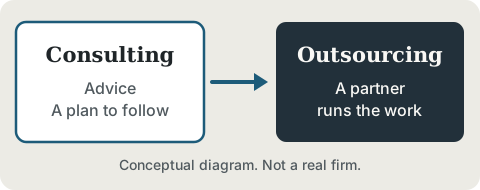
| Question | Consulting | Outsourcing |
|---|---|---|
| What is it usually for? | Advice on a bounded problem. | Ongoing delivery of a function. |
| How long does it usually last? | A limited time. | Often an ongoing arrangement under an agreement. |
| What does the organisation usually keep? | The decision and the work of acting on it. | Oversight of the function, while the provider does the work. |
Related
For advice on a specific problem, see Consulting.